What Was Chile Before Becoming a Democracy Again
| Republic of Chile República de Chile | |||||||||
|---|---|---|---|---|---|---|---|---|---|
| 1990–2022 | |||||||||
| Flag Glaze of arms | |||||||||
| Motto: Por la razón o la fuerza ("By reason or by force") | |||||||||
| Canticle:Himno Nacional de Republic of chile ("National Anthem of Republic of chile") | |||||||||
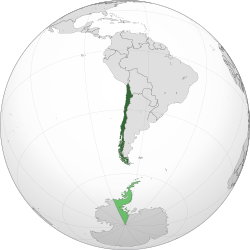 | |||||||||
| Uppercase | Santiago | ||||||||
| Common languages | Spanish | ||||||||
| Government | Unitary presidential constitutional republic | ||||||||
| President | |||||||||
| • 1990–94 | Patricio Aylwin first | ||||||||
| • 2017–22 | Sebastián Piñera last | ||||||||
| Historical era | Mail–Common cold War | ||||||||
| • Established | 11 March 1990 | ||||||||
| • Disestablished | xi March 2022 | ||||||||
| Population | |||||||||
| • 1990 | 13,178,782 | ||||||||
| • 2017 | 17,574,003 | ||||||||
| Currency | Chilean peso | ||||||||
| ISO 3166 code | CL | ||||||||
| |||||||||


The Chilean transition to democracy (Spanish: Transición a la democracia) is in political history the menstruation of time that succeeded the armed forces dictatorship of Pinochet in 1990. During this period democratic institutions were strengthened and the political power of the military machine was slowly rolled back. While mostly used for Chile in the 1990s, historians take so far not agreed on its end date or if information technology continues to the present.
The menstruation was characterized by an economic consensus around free market economics accompanied by rapid economic growth, a reject of anti-dictatorship insurgency that rejected the new commonwealth and political rule of a centre-left coalition led past 2 consecutive Christian Democrat presidencies. In cultural terms, Chile remained in the 1990s a bourgeois country with no divorce or abortion law. Noncombatant-military relations were a fragile matter during the 1990s and former dictator Augusto Pinochet remained commander-in-chief of the army.
The training for the transition began within the dictatorship itself when a Constitution establishing a transition itinerary was approved in a referendum. From eleven March 1981 to March 1990, several organic constitutional laws were approved, leading to the final restoration of democracy. After the 1988 plebiscite, the 1980 Constitution (which is still in effect today) was amended to ease provisions for time to come amendments to the constitution, create more seats in the senate, diminish the role of the National Security Quango, and equalize the number of civilian and military members (four members each).
Christian Democrat Patricio Aylwin served from 1990 to 1994 and was succeeded by some other Christian Democrat, Eduardo Frei Ruiz-Tagle (son of Eduardo Frei Montalva), leading the same coalition for a six-year term. Ricardo Lagos Escobar of the Socialist Party and the Political party for Commonwealth led the Concertacion to a narrower victory in the 2000 presidential election. His term ended on xi March 2006, when Michelle Bachelet of the Socialist Party took office.[1] Center-right investor and man of affairs Sebastián Piñera, of the National Renewal, assumed the presidency on eleven March 2010, afterward Bachelet's term expired. Bachelet returned to the office on eleven March 2014, beingness succeeded by Piñera in the post-obit term (2018–2022).
1988 plebiscite and reform of the Constitution [edit]
Passed nether tight war machine control in 1980, the Chilean constitution's legal dispositions were designed to atomic number 82 to the convocation of all citizens to a plebiscite during which the Chilean people would ratify a candidate, proposed by the Chief of Staff of the Chilean Armed Forces and by the General Director of the Carabineros, the national constabulary force, and who would become the President of Chile for an eight-yr term. In 1980, this meant that the Chilean people were supposed to approve Augusto Pinochet's candidacy, assuring him popular legitimacy and the sanction of a vote. If the people refused the junta'due south chosen candidate, the armed services would relinquish political command to the civilians, leading to presidential and parliamentary democratic elections the following year, putting an end to the military regime.
In 1987, Pinochet'south government passed a law allowing the creation of political parties and another police allowing the opening of national registers of voters. If the majority of the people voted "yes" to Pinochet'south plebiscite, he would have remained in power for the side by side 8 years. Instead, Congress was elected and installed on March 11, 1990.
Touch only one of my men, and forget about the dominion of law.
—Augusto Pinochet, 1989[two]
Context and causes of Pinochet's decision to follow the Constitution [edit]
Diverse factors led to Pinochet's decision to resume this procedure, including the state of affairs in the Soviet Union, where Mikhail Gorbachev had initiated the glasnost and the perestroika democratic reforms. Those reforms led to the fall of the Berlin Wall in 1989 and to the official cease of the Cold War, which was an important factor.
The Cold War had important consequences in Southward America, considered by the Us to be a full office of the Western Bloc, in contrast with the Eastern Bloc, a sectionalization born with the stop of Earth War Two and the Yalta Conference. Following the 1959 Cuban Revolution and the local implementation in several countries of Che Guevara's foco theory, the U.s. waged a war in South America against the "Communists subversives," leading to support in Chile of the right-wing, which would culminate with the coup of 1973 in Chile. In a few years, all of Southward America was covered by similar armed services dictatorships, chosen juntas. In Paraguay, Alfredo Stroessner was in power since 1954; in Brazil, left-fly President João Goulart was overthrown by a military coup in 1964; in Republic of bolivia, General Hugo Banzer overthrew leftist General Juan José Torres in 1971; in Uruguay, considered the "Switzerland" of South America, Juan María Bordaberry seized power in the June 27th 1973 coup. A "Dirty War" was waged all over the continent, culminating with Operation Condor, an agreement between security services of the Southern Cone, other Due south American countries, and the U.s. government which provided training to repress and assassinate domestic political opponents. In 1976, militaries seized power in Argentina and supported the 1980 "Cocaine Coup" of Luis García Meza Tejada in Bolivia, before grooming the Contras in Nicaragua where the Sandinista National Liberation Front, headed by Daniel Ortega, had taken power in 1979. Similar military coups took place in Guatemala and in Republic of el salvador. In the 1980s, yet, the situation progressively evolved in the earth as in S America, despite a renewal of the Common cold War from 1979 to 1985, the year during which Gorbachev replaced Konstantin Chernenko as leader of the USSR.

It is believed that the visit of Pope John Paul Two in Apr 1987 may have influenced Pinochet's decision to call for elections. The Pope is shown here at the Pontifical Catholic University of Chile on four April 1987.
Some other alleged reason of Pinochet's decision to phone call for elections was Pope John Paul Two'southward April 1987 visit to Chile: he visited Santiago, Viña del Mar, Valparaíso, Temuco, Punta Arenas, Puerto Montt and Antofagasta. Before his pilgrimage to Latin America, the pontiff criticized Pinochet's regime every bit "dictatorial" while speaking with reporters. According to The New York Times, he was "using unusually strong language" to criticize Pinochet and told the journalists that the Church building in Chile must not merely pray, but actively fight for the restoration of democracy in Chile.[3] During his 1987 Chilean visit, the Polish pope asked Chile'due south 31 Catholic bishops to entrada for free elections in the country.[4] According to George Weigel, he held a coming together with Pinochet during which they discussed the topic of the return to democracy. John Paul Two allegedly pushed Pinochet to accept a democratic opening of the regime, and fifty-fifty called for his resignation.[v] In 2007, Central Stanisław Dziwisz, acting as Pope John Paul II's secretary, confirmed that the Pope asked Pinochet to step downward and transfer power over to civilian authorities during his visit.[6] John Paul 2 also supported the Vicariate of Solidarity during his visit, which was a Church-led pro-democracy, anti-Pinochet organization. John Paul Ii visited the Vicariate of Solidarity'south offices, spoke with its workers, and "called upon them to continue their piece of work, emphasizing that the Gospel consistently urges respect for human rights."[7] Some take erroneously accused John Paul Two of affirming Pinochet's regime past appearing with the Chilean ruler in his balcony. Yet, Primal Roberto Tucci, organizer of John Paul II's pilgrimages, revealed that Pinochet tricked the pontiff by telling him he would have him to his living room, while in reality he took him to his balcony. Tucci claims that the pontiff was "furious."[eight]
Whatever the case, political advert was legalized on 5 September 1987, and became a key element of the campaign for the "NO" to the referendum, which countered the official campaign which presaged a return to a Popular Unity government in case of Pinochet's defeat. Finally, the "NO" to Pinochet won with 55.99% of the votes, confronting 44.01% of the votes. Equally a result, presidential and legislative elections were called for the following year.
Furthermore, in July 1989, a ramble referendum took identify after long negotiations between the government and the opposition. If approved, 54 constitutional reforms were to be implemented, amid which the reform of the way that the Constitution itself could be reformed, the restriction of state of emergency dispositions, the affirmation of political pluralism, the strengthening of constitutional rights as well every bit of the democratic principle and participation to the political life. All parties in the political spectrum supported the reforms, with the exception of the small right-wing Avanzada Nacional and other minor parties. Reforms were passed with 91.25% of the vote.
Aylwin administration [edit]

Pinochet congratulates new President Patricio Aylwin on inauguration mean solar day, 11 March 1990.
The Concertación coalition, which supported the render to republic, gathered the Christian Democrat Party (PDC), the Socialist Party (PS), the Party for Democracy (PPD) and the Social Democrat Radical Political party (PRSD). Christian Democrat Patricio Aylwin won a sweeping victory in the December 1989 elections, the first democratic elections since the 1970 election won by Salvador Allende. Patricio Aylwin had gathered iii,850,023 votes (55.17%), while the center-right supermarket tycoon Francisco Javier Errázuriz Talavera from the UCCP party managed to take 15.05% of the vote, whose main effect was lowering right-wing candidate Hernán Büchi's votes to 29.xl% (approximately 2 1000000 votes).

In December 1989, Patricio Aylwin, caput of the Concertación coalition, won the outset autonomous ballot in Chile since 1970.
The Concertación coalition dominated Chilean politics for much of the next two decades. In February 1991, it established the National Commission for Truth and Reconciliation, releasing the Rettig Written report on human being rights violations during Augusto Pinochet's dictatorship. This study, contested by human being rights NGOs and associations of political prisoners, counted only 2,279 cases of "disappearances" which could be proved and registered. Of course, the very nature of "disappearances" made such investigations very hard, while many victims were still intimidated by the government, and did non dare go to the local police heart to register themselves on lists, since the police officers were the same as during the dictatorship.
Several years later, the aforementioned trouble arose with the 2004 Valech Report, which counted virtually 30,000 victims of torture, among testimony from 35,000 people. However, the Rettig Report did list important detention and torture centers, such as the Esmeralda ship, the Víctor Jara Stadium, Villa Grimaldi, etc. Registration of victims of the dictatorship, and the following trials in the 2000s of military personnel guilty of human rights violations, dominated the struggle for the recognition of crimes committed during the dictatorship past human rights NGOs and associations of political prisoners, many of whom resided in exile.
Besides implementing the Rettig Commission, Aylwin'southward regime established a Comisión Especial de Pueblos indígenas (Special Commission of Ethnic People), whose report provided the intellectual framework of the "Indigenous Police" (ley indígena) or law n° 19 253. The law went into outcome on September 28, 1993[ix] and recognized the Mapuche people every bit an inherent part of the Chilean nation. Other indigenous people officially recognized included Aymaras, Atacameñas, Collas, Quechuas, Rapa-Nui, Yámanas and Kawashkars. Despite this state declaration of ethnic rights, conflicts brought by land-occupations and Mapuche'south claims led to land repression and the use of the anti-terrorist law against Mapuche activists, a police force instated by the military machine junta.
Frei Ruiz-Tagle assistants [edit]
Preparing for the 1993 election, the Concertación held primaries in May 1993, which pitted left-wing Ricardo Lagos (PPD) against Christian-Democrat Eduardo Frei Ruiz-Tagle, (PDC), the son of old President Eduardo Frei Montalva (1911–1982, President from 1964 to 1970). Eduardo Frei won these primaries past a large majority of 63%.
The right-wing, grouped as the Brotherhood for Chile, also held primaries between 2 candidates: Sebastián Piñera of the National Renewal (RN) the largest right-wing party at the time and who had supported the "NO" during the 1988 referendum on the return to noncombatant rule, and Arturo Alessandri Besa, onetime member of the National Party (PN), and the nephew of Jorge Alessandri , former President of the Republic during the term 1958 - 1964 and Presidential Candidate of the Correct-fly in the 1970 election . Alessandri won those primaries, and thus represented the Alliance for Chile against the Concertación.
Others candidates included José Piñera, who was the erstwhile Minister in the early 1980s that had implemented the constabulary granting property of copper to the Chilean Military machine and presented himself every bit an independent (vi%); ecologist Manfred Max-Neef (5.55%), representative of the Left-Fly Autonomous Culling, which gathered the Communist Party (PCC), MAPU (part of the Popular Unity coalition of Allende) and the Christian Left Party; Eugenio Pizarro Poblete (less than 5%); and finally Cristián Reitze Campos of the left-wing Humanist Party (1.i%).
On 28 May 1993, the Boinazo took place, during which paratroopers surrounded the Chilean Army headquarters located close past to the Palacio de la Moneda.[10] The motive for the military uprising was the opening of investigations concerning the "Pinocheques", or checks received by Pinochet for a full amount of $iii million in the frame of kickbacks from an arms deal.[11] A few days earlier (and unnoticed at the time), Jorge Schaulsohn, President of the Bedchamber of Deputies, had also denounced irregularities during arms trade committed by the Chilean Army through the intermediary of the FAMAE (Factories and Arsenals of the Ground forces of Republic of chile) — which was later connected to the Gerardo Huber case, a Chilean Ground forces Colonel and agent of DINA who was assassinated the previous twelvemonth.[11]
Eduardo Frei Ruiz-Tagle finally won the ballot in the first round in December 1993 with an absolute bulk of most 58% (more than 4 million votes) against Arturo Allesandri who gathered 24.4% (around i,700 000 votes). Eduardo Frei took office in March 1994 for a 6-year term until 2000. During his term, it was not possible to judge any military for his role during the dictatorship, while big sectors of the Chilean guild remained Pinochetista.
Arrest and trial of Pinochet and Lagos administration [edit]

Following an agreement betwixt Pinochet and Andrés Zaldívar, president of the Senate, Zaldavír voted to abolish September eleven as a National Holiday which celebrated the 1973 coup. Supporters of Pinochet had blocked whatsoever such attempts until so.[12] The same year, Pinochet traveled to London for dorsum surgery. One time there, he was arrested on the orders of Spanish judge Baltasar Garzón, provoking worldwide attention, not merely because of the history of Chile and South America, but also because this was one of the offset arrests of a dictator based on the universal jurisdiction principle. Pinochet tried to defend himself past referring to the Land Immunity Act of 1978, an statement rejected by British judicial organization. However, United kingdom of great britain and northern ireland Dwelling house Secretary Jack Straw released him on medical grounds, and refused to extradite him to Spain. Pinochet returned to Chile in March 2000. Upon descending the aeroplane in his wheelchair, he apace stood upwardly and saluted the auspicious crowd of supporters, including an army band playing his favorite armed forces march tunes, which was pending him at the airport in Santiago. President Ricardo Lagos, who had simply been sworn in on March 11, said the retired full general'southward televised arrival had damaged Chile's paradigm, while thousands demonstrated confronting him.[13]
Representing the Concertación coalition for democracy, Ricardo Lagos had narrowly won the election simply a few months before by a very tight margin of less than 200,000 votes (51.32%) against Joaquín Lavín who represented the right-wing Alliance for Chile (around 49%). None of the six candidates had obtained an absolute majority on the outset round held on Dec 12, 1999. Lagos was sworn-in for a 6-year term on March xi, 2000.
In June 2000, the Congress passed a new police which granted anonymity to members of the war machine who provide data on the desaparecidos.[fourteen] Meanwhile, the trials concerning human rights violations during the dictatorship continued. Pinochet was stripped of his parliamentary immunity in August 2000 by the Supreme Courtroom and was indicted by estimate Juan Guzmán Tapia. In 1999, Tapia had ordered the arrest of v military men, including General Pedro Espinoza Bravo of the DINA, for their role in the Caravan of Decease following September 11 coup. Arguing that the bodies of the "disappeared" were even so missing, he made jurisprudence which lifted any prescription on the crimes committed past the military. Pinochet'south trial continued until his decease on December 10, 2006, with alternating indictments for specific cases, lifting of immunities past the Supreme Courtroom or to the contrary amnesty from prosecution, with his wellness as master argument for, or confronting, his prosecution. In March 2005, the Supreme Court affirmed Pinochet'southward amnesty concerning the 1974 bump-off of General Carlos Prats in Buenos Aires, which had taken place as office of Operation Condor. However, he was deemed fit to stand trial for Operation Colombo, during which 119 political opponents were "disappeared" in Argentina. The Chilean justice also lifted his immunity on the Villa Grimaldi example, a detention and torture center in the outskirts of Santiago.
Pinochet, who withal benefited from a reputation of righteousness from his supporters, lost legitimacy when he was put under firm arrest on tax fraud and passport forgery following the publication of a report concerning the Riggs Bank in July 2004 by the US Senate Permanent Subcommittee on Investigations. The report was a consequence of investigations on financial fundings of the September 11th 2001 attacks in the US. The bank controlled between US$4 million and $8 million of Pinochet's avails, as he lived in Santiago in a small-scale house, hiding his wealth. According to the study, Riggs Bank participated in money laundering for Pinochet, setting up offshore shell corporations (referring to Pinochet as only "a erstwhile public official") and hiding his accounts from regulatory agencies. Related to Pinochet's and his family secret bank accounts in United States and in Caraïbs islands, this taxation fraud filing for an amount of $27 million shocked the conservative sectors who still supported him. 90 percentage of these funds were raised between 1990 and 1998, when Pinochet was chief of the Chilean armies, and essentially would accept come up from weapons trafficking when purchasing Belgian "Delusion" air-fighters in 1994, Dutch "Léopard" tanks, Swiss "Mowag" tanks, or by illegal sales of weapons to Croatia in the middle of the Balkans war. His wife Lucía Hiriart and his son Marco Antonio Pinochet were also sued for complicity. For the fourth fourth dimension in seven years, Pinochet was indicted by the Chilean justice.[15]
The Chilean regime took control in August 2005 of the Colonia Dignidad concentration army camp, directed by ex-Nazi Paul Schäfer.
2005 reform of the 1980 Constitution [edit]
Over fifty reforms to Pinochet's Constitution were approved in 2005, which eliminated some of the remaining undemocratic areas of the text, such as the existence of not-elected Senators (institutional senators, or senators for life) and the inability of the President to remove the Commander in Chief of the Armed Forces. These reforms led the President to controversially declare Chile'southward transition to democracy as complete. However, its anti-terrorist measures remained, which take been used confronting the indigenous Mapuche. Furthermore, the war machine all the same receives money from the copper industry.
Bachelet assistants [edit]
In 2006, the Concertación once more won the presidential election: Michelle Bachelet, Chile'southward offset woman president, beat Sebastián Piñera (Brotherhood for Chile), and obtained more than than 53% of the vote. Bachelet's outset political crisis occurred with massive protests past students who were enervating free omnibus fare and waiving of the academy admissions test (PSU) fee, amidst longer-term demands such every bit the abolitionism of the Organic Constitutional Law on Educational activity (LOCE), an stop to municipalization of subsidized pedagogy, a reform to the Full-time School Solar day policy (JEC) and a quality education for all. The protests peaked on May 30, 2006, when 790,000 students adhered to strikes and marches throughout the country, becoming Republic of chile's largest student demonstration of the past three decades.[xvi]
The 2006–2007 Chilean corruption scandals were a series of events in which the Chilean governing Concertación was under investigations of corruption.
In June 2007, General Raúl Iturriaga, the former deputy managing director of the DINA, was sentenced to 5 years' imprisonment for the abduction of Luis Dagoberto San Martin in 1974. Iturriaga had been in hiding from the authorities for a number of years[ description needed ] but was arrested in August 2007.[17]
The Cut merchandise-union federation called for demonstrations in August 2007. These went on during the night, and at least 670 people were arrested, including journalists and a mayor,[18] and 33 carabineros were injured.[19] The protests were aimed against the Bachelet government's complimentary market place policies. Socialist Senator Alejandro Navarro was injured by the law during the demonstrations,[20] although it subsequently emerged that he had striking and kicked police and is currently[ when? ] under investigation by the Senate Ethics Committee.[21] Senators from the opposition take requested that Navarro and other congressmen who participated in the protestation be removed from Congress for violating the constitutional commodity which bans congressmen from participating in demonstrations which "violate the peace".[22]
In Baronial 2007, a BBC correspondent wrote that well-nigh three million workers, roughly half the workforce, earned the minimum wage of $260 (£130) a month.[20] At the aforementioned time, Arturo Martínez, general secretarial assistant of the Cut, requested explanations from the government and accused it of having stirred up the tension.[23] Politicians from the eye-right Alianza and from the governing center-left Concertación have in plow criticized the CUT for the violence of the protest.[ commendation needed ]
Piñera assistants [edit]
![[icon]](https://upload.wikimedia.org/wikipedia/commons/thumb/1/1c/Wiki_letter_w_cropped.svg/20px-Wiki_letter_w_cropped.svg.png) | This section needs expansion. You can help by adding to it. (January 2015) |
Second Bachelet administration [edit]
2nd Piñera administration [edit]
Massive civilian protests started on October 18, 2019, when Chilean people demanded a new constitution, the power to end the transition menstruum, and start a real democracy.[24] The protests have hopes of reducing and eliminating social and economic inequality, improving health, education and other public systems, and ending the current pension organisation (AFP), amid other important issues.[ citation needed ] The appointed 26 April 2020 plebiscite has been delayed to 25 October due to the COVID-19 Pandemic, and the ensuing elections for a Constituent Assembly to write the new constitution have been themselves delayed from 25 October 2020 to xi Apr 2021. The elections were moved dorsum to fifteen-xvi May 2021 and completed successfully.
Encounter likewise [edit]
- 2006 educatee protests in Chile
- Transition to democracy
- No, a film about the 1988 referendum
References [edit]
- ^ "Background note". Section of Country.
- ^ Educación para la Ciudadanía: Democracia, capitalismo y estado de derecho (in Castilian). Ediciones Akal. 2007. p. 204. ISBN9788446035992 . Retrieved 8 June 2015.
- ^ Pope, on Latin Trip, Attacks Pinochet Regime The New York Times, ane Apr 1987
- ^ Pope Tells Chile's Bishops To Press for Free Elections; Pontiff Joins Pinochet on Palace Balcony The Washington Mail, 3 April 1987
- ^ Heraldo Muñoz, The Dictator's Shadow: Life under Augusto Pinochet, p. 183, Basic Books (2008), ISBN 0465002501
- ^ George Weigel, Biografía de Juan Pablo 2 – Testigo de Esperanza, Editorial Plaza & Janés (2003), ISBN 84-01-01304-vi
- ^ Timmerman, Jacobo Chile: Death in the Due south, p. 114, Alfred A. Knopf, Inc., 1987 ISBN 978-0-517-02902-2
- ^ Dlaczego Jan Paweł II wyszedł z Pinochetem na balkon Gazeta Wyborcza, 24 December 2009
- ^ "LEY Nº 19.253 – LEY INDÍGENA" (PDF). Archived from the original (PDF) on xxx October 2008.
- ^ Republic of chile: Illicit Republic of croatia Arms Sale Case in Final Stage [ permanent expressionless link ] , The Santiago Times, 4 September 2007 (in English)
- ^ a b El verdadero objetivo del "boinazo" de Pinochet Archived 2007-09-eleven at the Wayback Auto, Diario Siete, 25 September 2005 (in Castilian)
- ^ Chile abolishes coup holiday, BBC News, 20 August 1998
- ^ Thousands march against Pinochet, BBC, 4 March 2000
- ^ Soldier confirms Chile stadium killings, BBC, 27 June 2000 (in English)
- ^ U.S. sends back Pinochet girl, CNN, 28 Jan 2006
- ^ Riesco, Manuel (September–October 2007). "Is Pinochet dead?". New Left Review. New Left Review. II (47). Castilian pdf. Italian pdf.
- ^ Lagos, Claudia; McDonneln, Patrick J. (3 August 2007). "Pinochet-era general is defenseless". Los Angeles Times.
- ^ Martin, Claire (30 August 2007). "Affrontements violents lors des manifestations anti-Bachelet". rfi.fr. France: RFI.
- ^ Staff author (30 August 2007). "Ultimo rest cifra en 670 los detenidos en jornada de protesta". Radio Cooperativa.
- ^ a b Staff writer (xxx August 2007). "Clashes erupt at Chilean protests". BBC News. London: BBC.
- ^ Vergara, R.; Lazaeta, P. (five September 2007). "Navarro admite que golpeó dos veces "la mano" del carabinero". El Mercurio.
- ^ Cisternas, Hernán (31 August 2007). "Alianza analiza pedir inhabilidad de Navarro, Aguiló y Enríquez-Ominami". El Mercurio.
- ^ Staff author (30 Baronial 2007). "Arturo Martínez acusó al Gobierno de generar clima de violencia". Radio Cooperativa.
- ^ "'The constitution of the dictatorship has died': Chile agrees deal on reform vote". the Guardian. 15 November 2019.
External links [edit]
- Democratic Transition in Republic of chile from the Dean Peter Krogh Foreign Diplomacy Digital Archives
warrenwounducknow68.blogspot.com
Source: https://en.wikipedia.org/wiki/Chilean_transition_to_democracy

Enviar um comentário for "What Was Chile Before Becoming a Democracy Again"